Designing software from Tunisia. Building SILKLEARN for the AI era.

Or at least, that’s where the story began.

A note from the founder

It started with a dream

When I started SILKDEV, I was learning business in real time — writing my first professional emails, learning how to price a project, and figuring out how to sell without feeling like I was pretending. Every lesson came the hard way.

Four years later, we had a team: people from different countries and backgrounds, each carrying a vision of their own, choosing to build something alongside me. I felt nothing but pride working with them.

I’m still indebted to every single one of them. That part doesn’t go away.

Then AI arrived — and the market didn’t just shift. It collapsed overnight.

The craft we had spent years sharpening became something a prompt could imitate. Clients who once needed a team now needed a subscription. Developers who had spent a decade building expertise began seeing their roles disappear from the very job posts they used to fill.

We watched it happen in real time. And we had a choice: roll over and let it consume us, or place a real bet on a pivot.

When there’s a gold rush, sell the shovels.

So we stopped digging and started building the tools everyone rushing in would need. In a commoditized market, that is the position with leverage.

We stopped taking clients. And we started building.

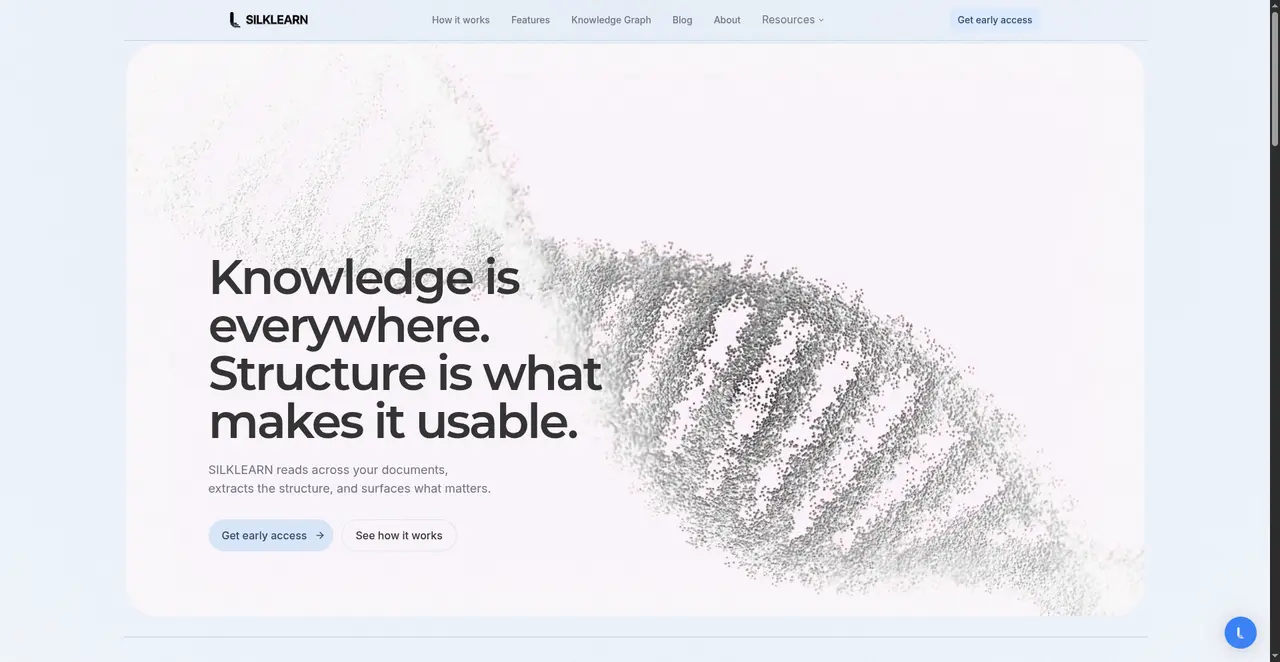
SILKLEARN is knowledge infrastructure that keeps compounding.

Imagine this for a second

What if knowledge could collide?

Steve Jobs spent a semester studying calligraphy at Reed College, dropped out, and had no obvious use for it. Ten years later, that stray semester helped shape why every Mac shipped with proportional spacing and multiple typefaces — and why every personal computer that followed eventually copied it. He didn’t apply calligraphy to typography. The two ideas collided inside him and produced something neither contained alone.

Galileo watched a chandelier swing in a cathedral in 1583 and saw the laws of pendulum motion. He was there for a church service; the pendulum wasn’t the point. But the way he had already structured everything he knew made the collision inevitable.

What would a person become if they carried both of those structures? Not Jobs’s opinions or Galileo’s conclusions, but the shape of how they connected things: the way Jobs moved between aesthetics, function, and urgency; the way Galileo could hold a wrong theory about tides for thirty years while still being right about what mattered.

We are not only what we know. We are the order our knowledge arrived in — the contradictions we had to hold, the gaps that forced us to build bridges nobody else needed. That structure is rarely written down. It lives between the lines of every document, inside the assumptions the author knew so well they forgot to explain them.

SILKLEARN is built to map that structure.

We’re building SILKLEARN full time.

Where we are now

We’re not taking on new clients right now.

If this idea resonates, the next step is here: https://www.silklearn.io

Birds didn’t know they inspired planes. But someone still had to build the plane.

SILKDEV

About SILKDEV

SILKDEV is now building SILKLEARN — knowledge infrastructure for turning scattered expertise into structured understanding people can follow, question, and build on.

Copyright © SILKDEV LLC. 2026

SILKDEV

About SILKDEV

SILKDEV is now building SILKLEARN — knowledge infrastructure for turning scattered expertise into structured understanding people can follow, question, and build on.

Copyright © SILKDEV LLC. 2026

SILKDEV

About SILKDEV

SILKDEV is now building SILKLEARN — knowledge infrastructure for turning scattered expertise into structured understanding people can follow, question, and build on.

Copyright © SILKDEV LLC. 2026